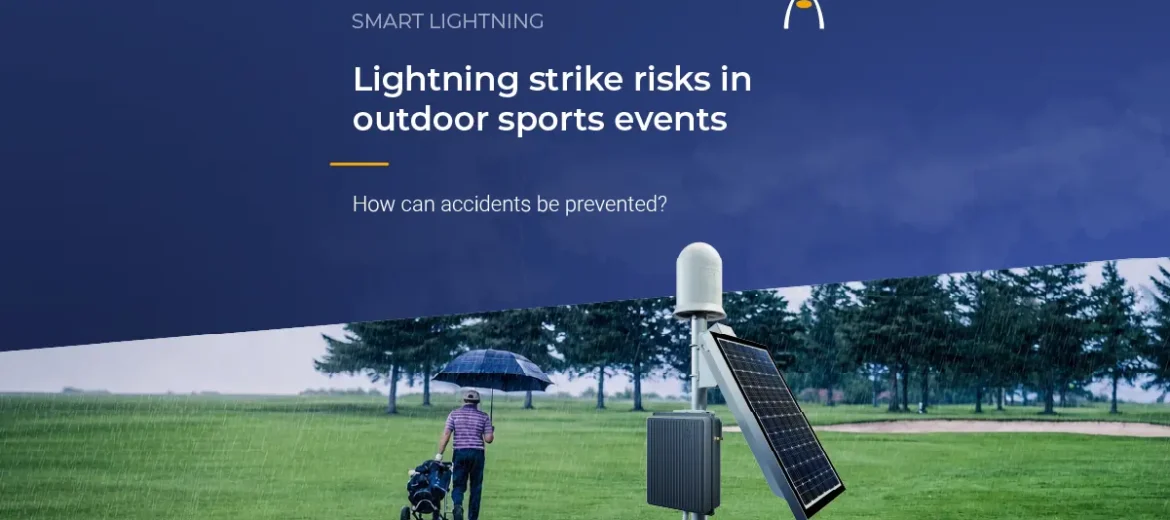
A lightning strike is a natural event which significantly affects all outdoor activities, especially outdoor sports events, and can pose a risk if the right preventive measures are not considered. The data obtained by different institutions corroborates the high frequency of lightning strikes in sports events.
The 2026 FIFA World Cup has become a real-life test of the lightning safety protocols described below.
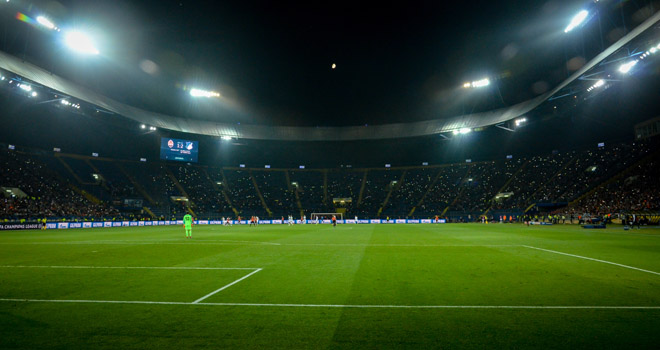
On 22 June 2026, the group stage match between France and Iraq at Lincoln Financial Field in Philadelphia became the first match in World Cup history to be suspended due to a thunderstorm, with France winning 1–0. The match was halted for over two hours after electrical activity was detected in the vicinity of the stadium. [9]
Subsequently, the round of 32 match between Mexico and Ecuador at the Estadio Ciudad de México was also delayed by a thunderstorm, forcing fans to take shelter in covered areas and players and officials to remain in the changing rooms before kick-off. [9]
The justification given by the organisers in both cases was the same as that described in this article for the NCAA: if lightning is detected within a radius of between 13 and 16 kilometres (8–10 miles) of the stadium, the match is halted immediately and a countdown is triggered (lasting 15 to 30 minutes depending on the venue), which is reset every time a new strike is recorded within that radius — that is, a direct application of the 30/30 rule which this very article later identifies as unreliable. [9]
FIFA has chosen to follow local weather regulations — in the US, the NOAA criteria — rather than setting its own standard, which confirms precisely the regulatory vacuum highlighted in this article: neither FIFA, nor the NCAA, nor golf has its own approved detection system, and all rely, in practice, on the same 30/30 rule with variations based on radius and time.
Lightning bolts pose a serious risk for people in open areas, and it is necessary to take preventive actions so no one gets hurt. These measures are taken with the aim of ensuring the security of athletes and fans.
It is important in all cases to make the population aware of the risks lightning can pose for safety as well as how to avoid being exposed to them.
Standards about lightning in events and sports activities
Every sport or organising institution has its own standards for lightning protection since they generally do not share a common framework. In many cases, there is not a specific standard which includes a particular protocol in case there is risk of a lightning strike, which puts people in danger.
Next, we will detail some associations or kinds of sports events which are affected by the presence of lightning strikes in open areas.
NCAA and NAIA standards for lightning protection.
The NCAA (The National Collegiate Athletic Association) is one of the sports associations with a specific standard for lightning protection. According to its internal regulation, a game should be suspended until the risk of a lightning strike disappears within a radius of 8 miles of the stadium. If this situation occurs, a preventive time of 30 minutes since the last lightning strike in the area will be provided.
However, this standard is based on the 30/30 rule. As explained in the last article, the 30/30 rule is not really effective and it poses safety risks.
The NAIA (National Association of Intercollegiate Athletics) has a similar standard, and as in the NCAA, it is recommended to assign a person as responsible for the meteorological security at events. For the person in this position, it could be really helpful to count on a lightning warning system, also known as a storm detection system, instead of making visual and hearing verifications and monitoring local weather forecasts.
Action protocol in case of thunderstorm risk in golf.
Golf is one of the sports with the largest open air playing areas. Because of the risk this involves, it is astonishing to find there are not specific standards about lightning protection.
However, golf rules mention some measures about the risk of lightning strike. In particular, rule 6-8a specifies that the player may interrupt the match if he thinks there is any risk of lightning strike. The committee may also suspend the competition if there is any risk of lightning strike (rule 6-8b), and players will not be able to restart the game while the alert is still activated. Even the explanatory notes of the rules manual mention the high mortality caused by lightning in this sport. This is the reason why committees are urged to take the necessary preventive actions to avoid these accidents.
Following the golf rules recommendations, we would like to remark that every golf course should have a lightning detection system.
Although some standards such as NCAA indicate the possibility of using lightning detectors for decision-making, in no case do these standards specify the features of the devices or the information time provided for the alerts to ensure security. Consequently, there is an absence of a reliable detection system.
NFL (National Football League) of The United States: Standards about lightning in the field for an emergency situation.
The American Football League of the USA (NFL) includes in its standards a special section for emergency situations which justifies a possible cancellation or delay of a match. Lightning is one of the climate events which represents a real threat during an American football game and therefore is a reason to stop the game, as the document indicates.
The Commissioner will be responsible for deciding when the match will be stopped and when it will be safe to restart it. However, the standard does not indicate anything about the procedures used to make decisions about lightning protection in stadiums.
Lightning Security in football leagues: FIFA Regulations.
FIFA has its own safety standards for stadiums. This document considers the risk of lightning strikes in section 9, which is dedicated to contingency plans in stadiums. Section 9 explains that the person responsible for the security in the stadium will be in charge of deciding in which cases the game will be stopped or cancelled, with weather conditions one of the possible reasons to do so.
Other football associations such as the Canadian Soccer Association have their own specific standards for safety and prevention in case of lightning. In this case, the CSA document correctly warns about the fact that the absence of rain and a blue sky does not mean there is no risk of lightning. Nevertheless, the CSA recommends the use of the 30/30 rule as a preventive measure, and as we already mentioned, this rule has important risks involved.
It is recommended to apply the necessary preventive and protection systems in order to avoid any unnecessary risk. These preventive measures aim to avoid accidents such as the one that happened in the Dominican Republic of Congo during the Bena Tshadi and Basang match.
Risk of lightning strikes in motorcycling.
Every motorcycling competition has its own competition standards. In the case of MotoGP, these standards do not have an action plan in case of thunderstorms, but it is true that some races have been stopped when the risk of a lightning strike has been detected. Even some circuits have its own ATSTORM® storm detector to guarantee the security both in circuits and stands.
Sometimes it is the country standard the one demanding to suspend the race in case of a thunderstorm, and the management board of the race will be responsible for evacuating drivers, corner workers and spectators.
In all cases, lightning near the track is more than enough for the management board to raise the red flag. This decision is made to protect drivers, corner workers and the cameramen who are using electronic equipment in high areas.
The risk of lightning strikes is one of the concerns for security managers in circuits and stadiums. They have to consider the difficulties of stopping a competition and the risks they expose themselves to if they do not.
But, do circuits and stadiums have appropriate devices which alert when there is a risk of lightning?
It is important to remember that a clear sky does not always mean an absence of lightning bolts. The only reliable way to evaluate the risk of lightning strikes is to have a lightning detector equipped with an electrostatic sensor with the capacity to record field increases in real time.
Lightning detection system in outdoor sports events and other activities.
A thunderstorm detection system should be part of the security and emergency plans and protocols. To base security decisions on the appearance of the sky or on the 30/30 rule implies a high risk.
The ATSTORM® storm detector measures the electrostatic field. When field values increase, it alerts of different risk levels, from a low to a high risk level. The electrostatic field is an indication of lightning strike risk; the higher the electrostatic field, the higher the risk of lightning strike.
In Aplicaciones Tecnológicas, we offer advice to provide the best solution based on the needs of each client. You can get information without compromise.